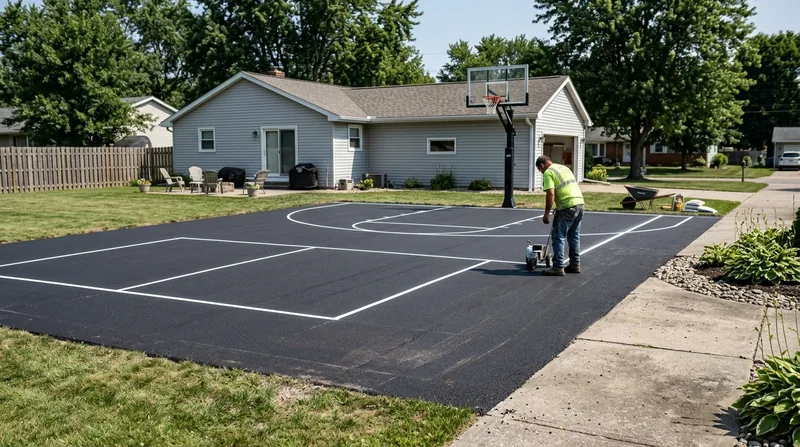




A backyard sports court or path in Toledo sits on the same challenging foundation as any driveway: lakebed clay that holds water and provides little support without a properly built base. Whether you're building a basketball court in Sylvania, a tennis court near Maumee, or a walking path through a residential lot in Perrysburg, sports court and path paving in Toledo demands the same grading, compaction, and drainage work that keeps a driveway from heaving and cracking through our freeze-thaw winters. We grade for pitch, compact the aggregate base to specification, and lay a smooth asphalt surface that handles the stress of play and the weight of snow removal equipment. With nearly 34 inches of precipitation a year and many cycles of freezing and thawing, a court or path built on a weak base will fail within two to three seasons. The difference between a court that lasts and one that cracks is the foundation work nobody sees. We start there.
Why Sports Court and Path Paving Matters in Toledo's Residential Landscape
Toledo's residential neighborhoods span from the Victorian grid of the Old West End through dense bungalow blocks to the post-war ranch belt and newer suburban growth in Sylvania and Perrysburg. Every one of these properties sits on the flat lakebed plain that was once the Great Black Swamp, and the clay underneath it holds water and settles unevenly. A backyard court or path without proper grading and a compacted base will show standing water after rain, soft edges that collapse under foot traffic, and alligator cracking by the second winter. The local terrain gives you almost no natural slope to shed water, so every inch of pitch must be built in deliberately. Add freeze-thaw cycles and the weight of regular use, and a poorly constructed court becomes a liability and a money pit.
- We grade the site to shed water at a quarter inch per foot of slope, preventing standing water and soft perimeter edges.
- We compact the aggregate base in lifts to specification, using proof rolling to verify bearing capacity before paving begins.
- We lay asphalt in a binder course and surface course, sized for the intended use and local freeze-thaw stress.
- We build in proper drainage around the court or path so water moves away from the structure and into the yard or storm system.
A well-built court or path will serve for 15 to 20 years with routine maintenance, while a court built on a weak or improperly graded base fails within three to five seasons and costs far more to fix than it would have to build right the first time.
Key info: In Toledo and surrounding communities like Holland, Northwood, and Rossford, municipal codes and HOA rules may govern the size, setback, and material of a court or path. Verify requirements with your city or homeowners association before work begins. Permits are required in some jurisdictions for impervious-surface additions, and Ohio 811 utility locates are required by law before any excavation work.
For more information on proper base preparation and grading in the Toledo area, consult the City of Toledo Building Department or your local village office.
How We Build a Sports Court or Path in Toledo: Process and Execution
Our approach to court and path paving mirrors the discipline we bring to driveway and parking lot work: measure the site, understand the drainage challenge, build the base correctly, and pave a smooth surface that holds up. We do not cut corners on grading or compaction, because asphalt is only as good as what sits underneath it. The work typically takes one to two weeks from site prep to final rolling, depending on site size and weather. We use the same hot mix asphalt and compaction equipment for courts and paths as we do for commercial parking lots, because the engineering is the same even if the footprint is smaller.
- We measure the site, stake the grade, and identify drainage patterns and utility locations.
- We excavate and grade the site to the required pitch, removing soft soil and importing compacted aggregate base as needed.
- We proof roll the base to verify it will support the asphalt and the loads it will carry.
- We pave a binder course, then a surface course, rolling each to density and leaving a smooth, even finish.
- We allow the asphalt to cure for at least 48 hours before the court or path is open to use.
This process ensures a court or path that will not heave, settle, or crack under the stress of play and Toledo's winter weather.
Example: A residential basketball court in Ottawa Hills, 2,400 square feet, with a clay base and poor drainage, required full excavation, 18 inches of compacted aggregate, and two courses of asphalt. Grading work was critical because the lot sloped toward the house. The finished court sheds water in all directions and has held up through three winters without cracking or settling.
If you are planning a court or path and want to understand the grading and base work involved, see our detailed guide to gravel driveway installation and grading, which covers the same compaction and drainage principles we apply to courts and paths.
Sports Court and Path Paving Methods and Materials
| Approach | Description | Best for |
|---|---|---|
| Full-depth construction | Excavate to subgrade, import and compact aggregate base, pave binder and surface courses. | New courts or paths on poor or unproven soil, or sites with existing drainage problems. |
| Base repair and overlay | Identify weak spots in existing base, add compacted aggregate, pave a new surface course. | Existing courts or paths with soft edges or settled areas but sound subgrade. |
| Resurface only | Mill or grind the top course and pave a new surface, assuming base is sound. | Courts or paths with surface wear but no heave, settling, or base failure. |
| Recycled asphalt base | Use RAP (reclaimed asphalt pavement) as part of the aggregate base layer, then pave new asphalt. | Budget-conscious projects where the base does not require full excavation and the court is not in a protected area. |
Each method is priced and scoped on site. We assess the existing conditions, soil bearing, drainage, and intended use before recommending the right approach.
Sports Court and Path Paving Cost in Toledo: What to Expect
A backyard sports court or path in Toledo typically costs starting at $8,500 for a small court (1,500 to 2,000 square feet) with a solid existing base or minimal grading work. Larger courts, complex sites with poor drainage, or sites requiring full excavation and base replacement will run higher. The largest cost driver is the work below the asphalt: grading, compaction, and drainage. A court on a well-prepared lot costs less than one built on clay with standing water and soft edges. A 2,400-square-foot basketball court with full base work typically runs $10,000 to $14,000. A longer walking path with light use and existing grading may run $6,000 to $8,000. A tennis court (2,600 square feet) with full base and drainage typically runs $12,000 to $16,000.
The estimate includes measurement, site assessment, and a written scope with tonnage specifications and material grades. We do not offer a price per square foot because asphalt is quoted on site, and the cost of the base work varies with soil conditions, drainage, and access. Get two or three estimates from local contractors and compare the scope, not just the price. A low bid that skips base work or proper grading will cost you far more in repairs within a few seasons.
For a detailed pricing overview and to understand how other services affect your overall cost, visit our pricing page. To request a free, no-obligation estimate for your court or path, contact us at (419) 574-4896.
Sports Court and Path Paving Near Me: What Toledo Homeowners Should Know When Hiring a Contractor
A sports court or path is a significant investment, and choosing the right contractor matters as much as the design. Verify that any contractor you hire is fully insured and carries liability and property damage coverage. Ask for references from recent court or path work in your area, and call them to ask about the quality of the base work and whether the court or path has held up through at least one winter. Understand what your municipality requires in terms of permits, setbacks, and impervious-surface limits. If you live in a master-planned community or an HOA, verify architectural standards and material approval before signing a contract. Do not sign a contract that does not include a written scope, tonnage specifications, and a completion timeline. Be wary of unsolicited door-to-door offers, large cash deposits before work begins, or contractors with out-of-state plates who claim to have leftover asphalt from a nearby job.
- Ask the contractor for a written estimate that specifies the base thickness, asphalt thickness, and tonnage of material.
- Verify that the contractor will pull any required permits or will help you navigate the permitting process with your city or village.
- Confirm that Ohio 811 utility locates will be called before any excavation work begins.
- Ask whether the contractor offers a workmanship warranty and for how long (one to three years is standard).
- Do not expect the contractor to offer a lifetime warranty on the asphalt itself, asphalt is a material and carries no manufacturer warranty.
A local contractor who has built courts and paths in Toledo and surrounding communities like Sylvania, Maumee, and Perrysburg understands the soil, the drainage challenges, and the freeze-thaw cycles that dominate this region. That local knowledge is worth more than a low price from a crew passing through. For help finding and vetting a contractor, contact us for a free estimate and a no-pressure conversation about your project.
Sports Court & Path Paving in Toledo: Pricing Guide
| Service | Price | Details |
|---|---|---|
| Small court or path (1,500 to 2,000 sq ft) | Starting at $8,500 | Minimal grading and base work, solid existing soil, standard asphalt paving and finishing. |
| Standard basketball or tennis court (2,400 to 2,600 sq ft) | Starting at $10,500 | Full base preparation, grading for drainage, two-course asphalt, proper pitch and compaction. |
| Large court or path with poor drainage or clay base | Starting at $12,000 | Full excavation, imported aggregate base, proof rolling, grading work dominates cost, two-course asphalt. |
| Complex site or extensive base repair | On estimate | Site assessment required to determine soil conditions, utility conflicts, drainage needs, and base scope. |
| Travel and mobilization | Included | No separate travel charge for Toledo and surrounding communities within service area. |
| Free estimate | No cost | Written scope and pricing within 24 hours, no obligation to book, call (419) 574-4896. |
Indicative pricing, the exact cost depends on square footage, finish, and site access. Free personalized estimate within 24h at (419) 574-4896.


